Lemon Cheesecake Recipe (Creamy, Tangy & Foolproof Guide)
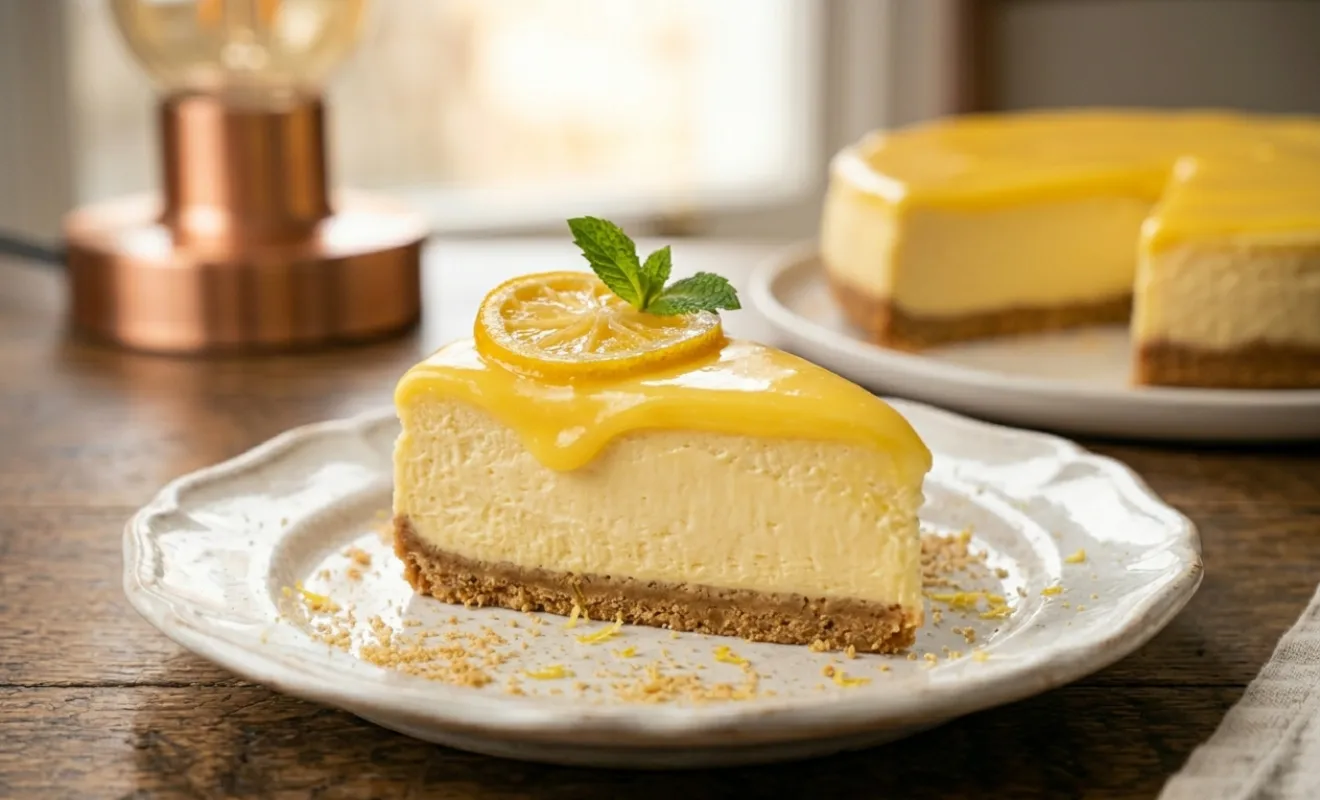
Lemon cheesecake is one of those desserts that manages to feel both rich and refreshing at once. It starts with a buttery graham cracker crust, builds up to a velvety cream cheese filling, and finishes with a bright, glossy lemon curd topping.
The flavor comes from two things working together. Fresh lemon zest carries the aromatic, floral depth from the peel. Fresh lemon juice brings the sharp, clean acidity. Together, they give the cream cheese filling a citrus punch that plain cheesecake simply cannot match.
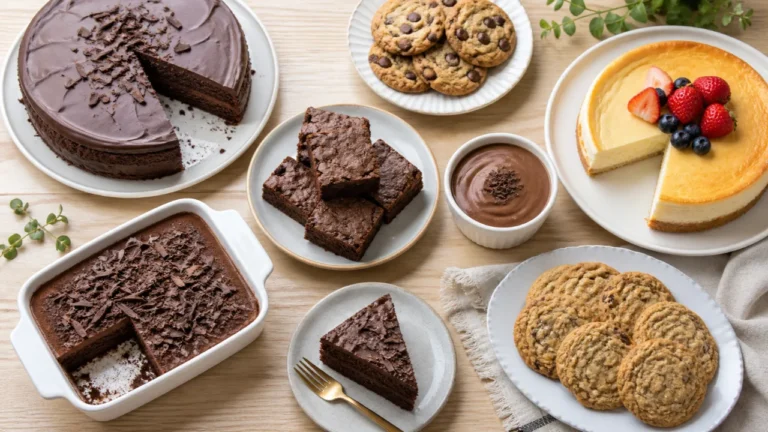
If you are exploring desserts for the first time, our dessert recipes guide covers everything from no-bake options to baked classics — a great place to start before diving into this recipe.
This guide walks you through every step — from pressing the crust to slicing the finished cheesecake. Whether you are making your first homemade lemon cheesecake or trying to fix past mistakes, everything you need is here.
What Is Lemon Cheesecake?
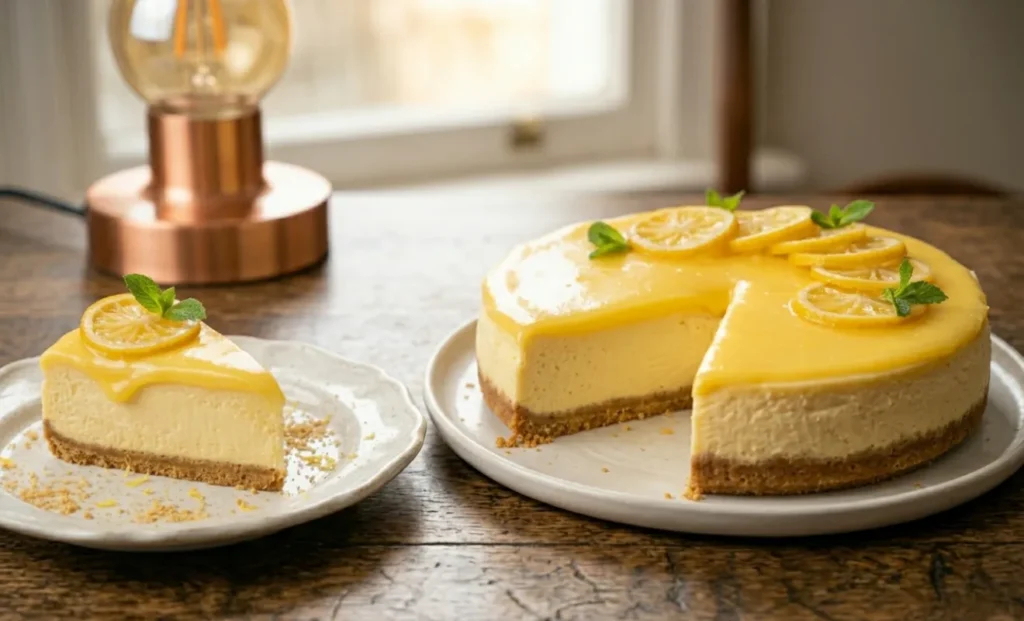
Lemon cheesecake is a baked or chilled citrus dessert made with a cream cheese filling flavored with fresh lemon juice and lemon zest, set inside a buttery crumb crust.
It belongs to the cheesecake family but stands apart from the classic version. The lemon adds brightness and acidity that cuts through the natural richness of cream cheese. The result is a creamy dessert without feeling heavy, which is why it works equally well as a dinner-party showstopper or a simple weekend bake.
There are two main styles: baked lemon cheesecake, which uses eggs and a water bath for a dense, smooth texture; and no-bake lemon cheesecake, which uses whipped cream for a lighter, mousse-like filling set in the refrigerator.
What Makes Lemon Cheesecake So Special
Classic cheesecake is sweet and dense. Add lemon, and the whole dessert shifts. The citrus edge wakes up your palate and makes every bite feel a little lighter than it actually is.
Balance is everything here. Too much lemon juice and the filling turns sharp and one-dimensional. Too little and you have just a faintly flavored cheesecake. The sweet spot is a creamy, tangy filling where neither element dominates.
Lemon also pairs naturally with dairy. The bright acidity softens the richness of cream cheese in a way that no other flavoring quite does. That natural harmony is why a creamy lemon cheesecake shows up on dessert tables across every season.
The 3 Essential Parts of Lemon Cheesecake
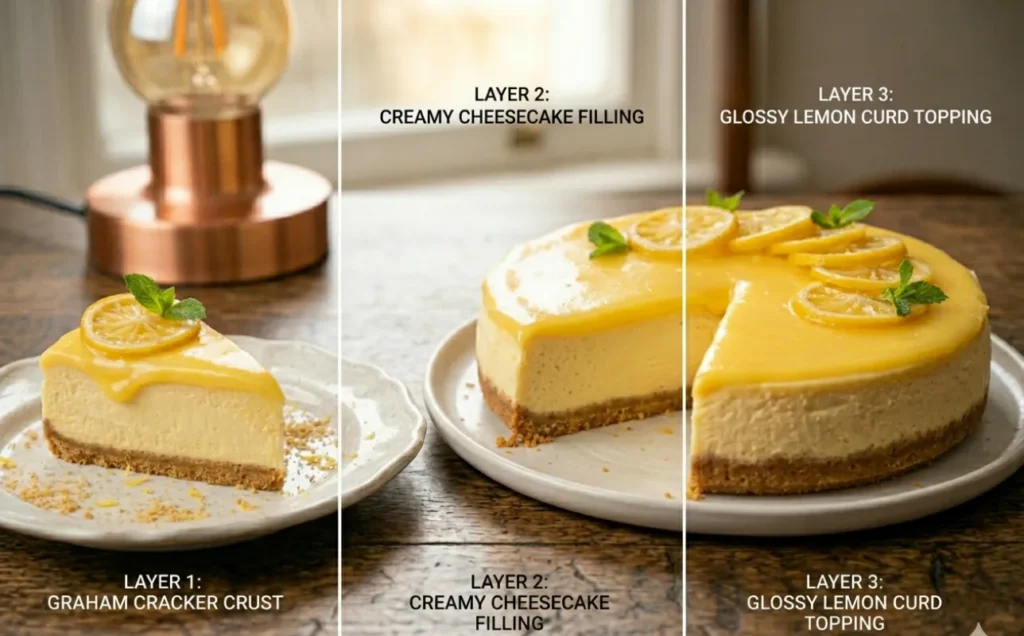
The Buttery Crumb Crust
The crust is the structural foundation. A well-made crumb crust is compact, buttery, and slightly crisp — firm enough to hold a clean slice but not so hard it fights the fork. Graham crackers are the standard choice because they crush evenly and carry just enough sweetness to complement the filling without competing with it.
The Creamy Lemon Cheesecake Filling
The cheesecake filling is where the flavor lives. It is built from full-fat cream cheese, sugar, eggs, sour cream, lemon juice, and lemon zest. When the ingredients are at the right temperature and mixed correctly, the baked texture lands somewhere between dense and silky — not airy, not rubbery. The lemon flavor comes through cleanly without drowning the cream cheese base.
The Bright Lemon Curd Topping
Lemon curd is a thick, glossy sauce made by cooking lemon juice, egg yolks, sugar, and butter until the mixture thickens. Spread over the surface of a chilled cheesecake, it adds concentrated citrus flavor, a polished visual finish, and a welcome contrast to the creaminess underneath. It is optional — but it elevates the dessert noticeably.
Key Ingredients for Lemon Cheesecake
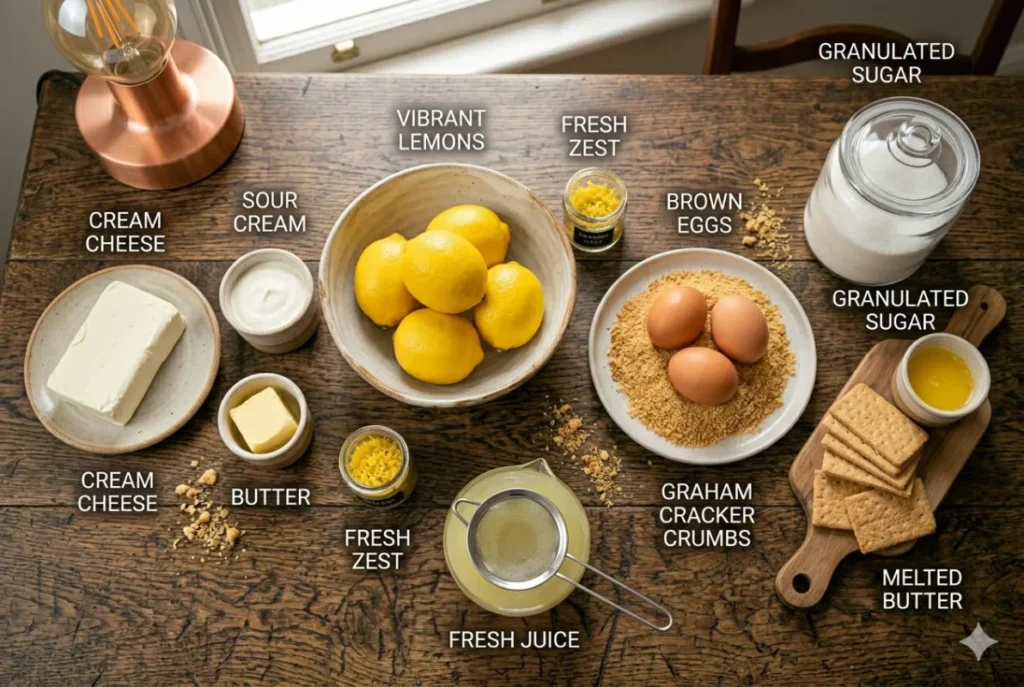
Before you start, gather everything and let your dairy ingredients come to room temperature. Cold cream cheese, cold eggs, and cold sour cream are the single most common causes of a lumpy, dense, or cracked cheesecake.
Graham Cracker Crust Ingredients
| Ingredient | Amount | Notes |
|---|---|---|
| Graham cracker crumbs Base | 1½ cups (~12 crackers) | Crush to a fine, even texture |
| Unsalted butter, melted Bind | 5 tablespoons | Binds the crumbs |
| Granulated sugar Sweet | 2 tablespoons | Adds mild sweetness |
| Salt Balance | Pinch | Sharpens the overall flavor |
Cheesecake Filling Ingredients
| Ingredient | Amount | Notes |
|---|---|---|
| Full-fat cream cheese Base | 24 oz (3 blocks) | Room temperature — non-negotiable |
| Granulated sugar Sweet | 1 cup | |
| Sour cream Silky | ½ cup | Adds silkiness and a gentle tang |
| Eggs Bind | 3 large | Room temperature, added one at a time |
| Fresh lemon zest Fresh | 2 tablespoons (~2 lemons) | Use a microplane for fine, dry zest |
| Fresh lemon juice Bright | 3 tablespoons | Always fresh — bottled falls flat |
| Vanilla extract Aroma | 1 teaspoon | |
| Salt Balance | ¼ teaspoon | Balances the sweetness |
Optional Toppings
- Homemade or store-bought lemon curd
- Whipped cream, piped or dolloped
- Fresh blueberries or raspberries
- Candied lemon slices
- A light dusting of powdered sugar
Start With a Crumb Crust
A soggy or crumbly crust can undermine even a perfect filling. The good news: a solid crumb crust takes about five minutes and only three ingredients. Get it right once, and you will never think twice about it again.
Graham Cracker Crust
Crush the crackers to fine, even crumbs — a food processor takes 30 seconds, or a zip-lock bag and rolling pin works just as well. Mix with melted butter and sugar until the crumbs clump when you squeeze them, like slightly damp sand.
Press the mixture firmly into the base of a springform pan. Use the flat bottom of a glass to compact it tightly and push it a little way up the sides. Bake at 325°F (163°C) for 8 to 10 minutes before you add the filling. This short pre-bake firms the crust and eliminates any sogginess.
Crust Comparison
| Crust Type | Flavor Profile | Best For | Prep Notes |
|---|---|---|---|
| Graham cracker Classic | Sweet, mild, neutral | Classic baked cheesecake | Most widely available; crushes evenly |
| Gingersnap Spiced | Warm, spiced, slightly sharp | Bold lemon flavor combinations | Use 1:1 swap; pairs beautifully with lemon |
| Digestive biscuit Buttery | Buttery, lightly sweet | No-bake versions; British-style | Less sweet than graham; sets cleanly |
| Almond flour Gluten-free | Nutty, rich, crumbly | Gluten-free cheesecake | Mix with butter and sugar; press firmly |
Make the Lemon Cheesecake Filling
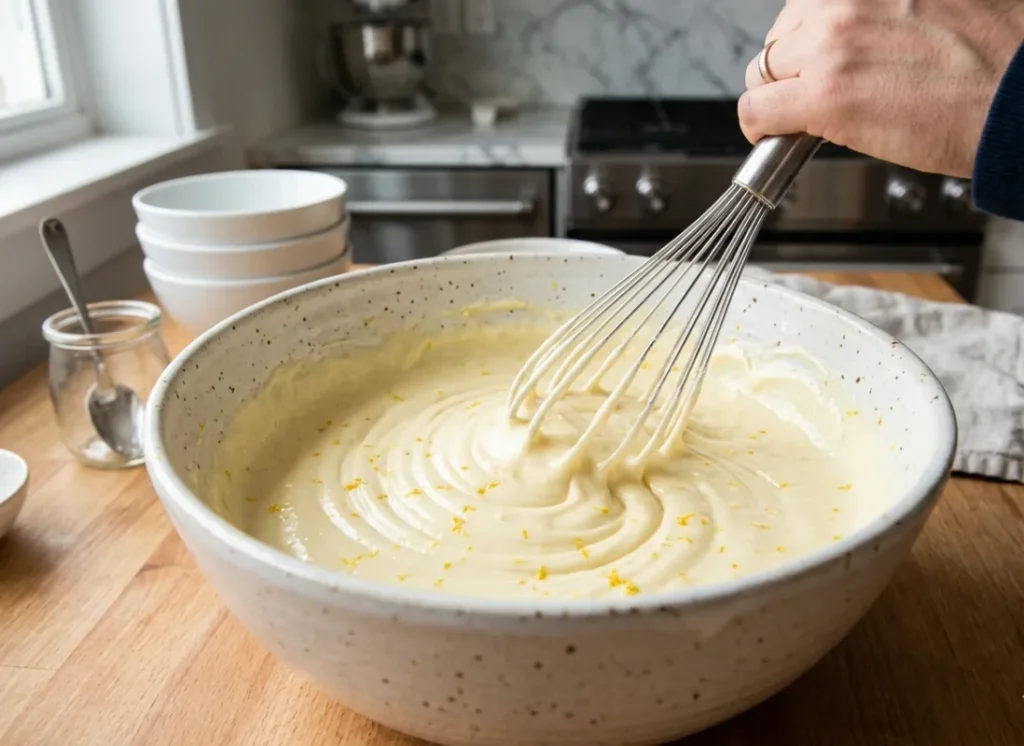
The filling is where most bakers go wrong — and where most of those errors are entirely preventable. Two things matter above everything else: ingredient temperature and how you mix.
Why Room Temperature Ingredients Matter
Cold cream cheese does not blend smoothly. It clumps, and those lumps do not fully disappear during baking. The same problem applies to cold eggs and cold sour cream. Take your dairy and eggs out of the refrigerator at least one hour before you start. Room temperature ingredients combine quickly, produce a smooth batter, and bake more evenly from edge to center.
Lemon Zest vs Lemon Juice
These two ingredients are not interchangeable — each does a distinct job. Lemon zest holds the essential oils from the lemon peel. It delivers an intense, aromatic lemon flavor that juice alone simply cannot provide. Lemon juice contributes the bright, tart acidity that makes the filling taste unmistakably like lemon.
Always zest your lemons before juicing them. A whole lemon is far easier to grip on a microplane than a squeezed one. Grate only the yellow surface — the white pith underneath is bitter.
Mixing order: Beat cream cheese alone until completely smooth. Add sugar and beat again. Add eggs one at a time on low speed — rushing this traps air, which expands in the oven and causes cracks. Finally, fold in sour cream, lemon juice, lemon zest, and vanilla by hand or on the lowest mixer setting.
Cheesecake Water Bath (And Why It Matters)
A water bath — also called a bain-marie — is a technique where the cheesecake pan sits inside a larger pan of hot water during baking. The water moderates the oven temperature around the pan and adds humidity, so the cheesecake bakes slowly and evenly from edge to center.
Without it, the outer edges firm up before the center has set. That uneven tension is the direct cause of surface cracks. A water bath eliminates that tension.
How to Set Up a Water Bath
- Wrap the outside of your springform pan tightly with two layers of heavy-duty aluminum foil — this keeps water from leaking through the base seam.
- Sit the wrapped pan inside a large, deep roasting pan.
- Fill the roasting pan with about one inch of very hot water.
- Transfer the whole setup carefully into a 325°F (163°C) oven.
- The cheesecake is ready when the outer two inches are set, and the center has a slow, gentle wobble — like soft-set gelatin.
Water Bath Alternatives
Foil leaks are frustrating. These two alternatives are simpler and still help significantly:
- Steam method: Place a separate pan of boiling water on the rack below the cheesecake. The oven humidity protects the filling without any foil wrapping.
- Silicone sleeve: A purpose-made silicone sleeve fits around the springform pan, creates a watertight seal, and is completely reusable.
Neither is quite as effective as a direct water bath, but both give better results than baking with no moisture at all.
How to Prevent Cheesecake From Cracking
Cracks are never random. They always trace back to one of the same five fixable causes. Here is what to watch for and how to prevent each one.
| Cause | What Goes Wrong | The Fix |
|---|---|---|
| Overmixing after adding eggs Air | Trapped air expands in the oven and fractures the surface | Mix on low speed after each egg — just until combined |
| Overbaking Dry | The filling dries out, pulls away from the sides, and cracks | Pull it out when the center still wobbles slightly |
| Temperature shock Cooling | Rapid cooling makes the filling contract suddenly | Cool in the oven — door slightly ajar — for at least 1 hour |
| Skipping the water bath Moisture | Dry oven heat sets the edges far faster than the center | Use a water bath or the steam method above |
| Cold cream cheese Texture | Lumps weaken the structure and cause uneven setting | Always bring cream cheese to room temperature first |
Even with perfect technique, a small crack sometimes appears. Lemon curd covers it completely. Flavor is unaffected. No one at the table will know.
Best Lemons for Lemon Cheesecake
Not all lemons taste the same. The variety you choose affects how tart, floral, or intense your filling turns out. Here is a quick comparison of the most common options.
| Lemon Type | Flavor Profile | Best Use | Notes |
|---|---|---|---|
| Eureka lemon Classic | Classic tart, sharp, clean | Traditional lemon cheesecake recipe | Most widely sold; consistent acidity year-round |
| Lisbon lemon Strong | High acidity, thin-skinned | Strong citrus flavor; lemon curd | Very similar to Eureka; interchangeable in recipes |
| Meyer lemon Sweet | Sweeter, floral, low acidity | Delicate, fragrant lemon cheesecake | Reduce sugar slightly; yields softer flavor |
| Sicilian lemon Aromatic | Bright, aromatic, complex | Elevated homemade lemon cheesecake | Excellent zest; seasonal availability varies |
For a classic lemon cheesecake recipe, Eureka or Lisbon lemons give the most reliable result. Meyer lemons work beautifully if you want a softer, more floral flavor — just ease back on the sugar by a tablespoon or two.
Make the Lemon Curd Topping
Lemon curd is a smooth, glossy spread made by gently cooking lemon juice, egg yolks, sugar, and butter until the mixture thickens. It is sharper and more intensely citrusy than the cheesecake filling itself, which makes it a natural contrast when spooned over the top.
Store-bought lemon curd saves time and works fine. Homemade takes about 10 minutes and tastes noticeably better — brighter, fresher, and less sweet.
Ingredients for Lemon Curd
- 3 large egg yolks
- ½ cup fresh lemon juice (from 3 to 4 lemons)
- 2 teaspoons lemon zest
- ½ cup granulated sugar
- 4 tablespoons unsalted butter, cut into small cubes
- Pinch of salt
Quick Lemon Curd Method
- Whisk egg yolks, lemon juice, lemon zest, and sugar together in a small saucepan.
- Cook over medium-low heat, stirring constantly, for 8 to 10 minutes until the curd coats the back of a spoon.
- Take the pan off the heat. Add butter one piece at a time, stirring until each piece melts fully.
- Strain through a fine-mesh sieve into a clean bowl to remove any cooked egg bits.
- Press plastic wrap directly onto the surface to stop skin from forming. Refrigerate until completely cool.
- Once the cheesecake has chilled fully, spoon the lemon curd over the top and spread from the center outward.
Optional Garnishes and Toppings
The cheesecake is complete with just the lemon curd. But if you are serving guests, a few finishing details make it look genuinely impressive.
- Whipped cream: Pipe small rosettes around the outer edge with a star tip. It is the classic presentation and takes two minutes.
- Fresh berries: Blueberries and raspberries pair exceptionally well with lemon. Scatter over the curd or arrange in a neat ring around the edge.
- Candied lemon slices: Simmer thin lemon rounds in a simple syrup for 15 to 20 minutes, then let them dry on a wire rack. They look striking and add a chewy, sweet-tart bite.
- Mint leaves: A small sprig or two adds color and a clean, fresh flavor alongside the citrus.
- Powdered sugar: A fine dusting over the whipped cream or curd adds an elegant, bakery-style finish.
Lemon Cheesecake Success Tips
| Tip | Why It Matters |
|---|---|
| Use full-fat cream cheese only Key | Low-fat versions have excess water content — the filling will not set properly |
| Zest the lemons before juicing Prep | A whole lemon grips the microplane far better than a squeezed one |
| Keep the oven door closed during baking Heat | Every time the door opens, heat escapes and creates temperature swings that crack the surface |
| Cool in the oven with the door slightly open Cooling | Rapid temperature change causes the filling to contract and split |
| Chill for at least 6 hours (overnight is ideal) Set | The filling needs time to firm up completely — do not rush this step |
| Run a knife around the edge before releasing Release | The filling contracts slightly as it cools; freeing the edge prevents surface tears |
| Slice with a hot, dry knife Serve | Dip the blade in hot water and wipe clean between every cut for neat, restaurant-quality slices |
How to Store Lemon Cheesecake
Refrigerating Cheesecake
Cover the surface loosely with plastic wrap, or transfer the slices to an airtight container. It keeps well for up to 5 days in the refrigerator. The lemon curd topping stays fresh for the same period alongside the filling.
Freezing Cheesecake
Let the cheesecake chill fully in the refrigerator before freezing. Wrap individual slices tightly in plastic wrap, then in a layer of foil. Freeze for up to 2 months. Thaw overnight in the refrigerator. Add whipped cream or fresh garnishes only after thawing — not before.
Shelf Life at a Glance
| Storage Method | How Long | Key Tip |
|---|---|---|
| Room temperature Short-term | 2 hours maximum | Do not leave out longer — cream cheese spoils quickly |
| Refrigerator Best | Up to 5 days | Cover tightly so the filling does not absorb fridge odors |
| Freezer Long-term | Up to 2 months | Wrap in plastic wrap and foil; add fresh toppings after thawing |
Lemon Cheesecake Variations
No-Bake Lemon Cheesecake
A no-bake lemon cheesecake sets in the refrigerator without eggs or an oven. The filling combines cream cheese, whipped cream, powdered sugar, fresh lemon juice, and zest. Chilling for at least 4 hours allows it to firm up. The texture is light and mousse-like, making it a quick and low-effort alternative to baked cheesecake.
Lemon Blueberry Cheesecake
Lemon and blueberry create a naturally balanced flavor. Blueberries can be mixed into the batter or layered as a compote. The sweetness of the berries softens the tart lemon and adds visual appeal, making it ideal for presentation-focused desserts.
Mini Lemon Cheesecakes
These are baked in a muffin tin and portioned individually. A small crust base is pressed into each liner, filled with batter, and baked at 325°F for 18–22 minutes. They are convenient, easy to serve, and perfect for gatherings or controlled portions.
Gluten-Free Lemon Cheesecake
The filling is naturally gluten-free. The crust can be made with gluten-free cookies, almond flour, or oat-based alternatives. Always verify ingredients if preparing for someone with gluten intolerance or celiac disease.
Vegan Lemon Cheesecake
A vegan version replaces dairy and eggs with plant-based options like dairy-free cream cheese, flax eggs, coconut cream, and vegan butter. While the texture is slightly different, the bright lemon flavor remains strong and satisfying.
Lemon Cheesecake Variations at a Glance
| Variation | Key Difference | Best For |
|---|---|---|
| Classic baked Traditional | Eggs + water bath; dense and smooth | Best flavor and texture; experienced bakers |
| No-bake lemon Easy | No eggs or oven; mousse-like texture | Quick prep; hot-weather baking; beginners |
| Lemon blueberry Fruity | Blueberry compote or fresh berries added | Visual presentation; flavor variety |
| Mini cheesecakes Portion | Baked in a muffin tin; individually portioned | Parties, potlucks, portion control |
| Gluten-free GF | GF crust; filling is already gluten-free | Dietary needs; celiac-safe baking |
| Vegan Plant-based | Dairy-free; flax eggs; plant-based butter | Fully plant-based diets |
Conclusion
Lemon cheesecake is the kind of dessert that feels impressive without being overly complicated. The balance of creamy filling, buttery crust, and bright citrus flavor makes it a reliable recipe for everything from family dinners to special occasions.
The key is patience — use room-temperature ingredients, avoid overmixing, bake gently, and allow enough chilling time before slicing. Those small details are what create the smooth texture and clean lemon flavor that make a homemade cheesecake stand out.
You can keep it classic with a simple lemon curd topping or experiment with berries, whipped cream, or mini cheesecake versions. Once you master the base recipe, it becomes one of the most versatile desserts you can make at home.
If you’d like to learn more about the origins and different styles of cheesecake, this guide offers a helpful overview.